
Hi, I'm Colten.
I'm a solutions engineer. I keep systems simple, stable, and easy to work on.
Husband · Dad of four · Montana
Listen to my music (opens in a new tab)

Fig. 00 · My photo, out in the Bitterroot, Montana
About Me
I'm a dad of four. That shapes how I build more than anything else.
I want what I build to still be running years later, and still make sense.
Years at Amazon and Starbucks taught me the same lesson: good engineering is technical depth plus real care for the people using it.
Married to my best friend. Four kids.
Montana. Remote for 5+ years.
Trails, chickens, reading with the kids.
Simple systems, clear code, alerts I trust.


Experience

Senior DevOps Engineer
2025 to PresentManage the Healthfirst lakehouse: data management, permissions, compute, and processes. Support the Information Management org on DevOps.
Key Contributions
- Design, build, and run CI/CD pipelines for Healthfirst applications
- Manage lakehouse permissions, compute, and data-management processes
- Collaborate with development teams to automate deployments and codify configurations
- Provide DevOps support across the Information Management org
Skills

Application Developer II
2024 to 2025Supported and customized ServiceNow for 10,000+ users while implementing new integrations, refining standards for development teams, and establishing federated development processes.
Key Contributions
- Architected CI/CD pipelines for three projects, reducing deployment times from 1+ hour to 5 minutes
- Developed Python/TypeScript automation detecting hardware failures across 10,000+ stores
- Mentored three team members on development and security best practices
- Refined logging and coding standards for two development teams (15 engineers)
- Implemented SAP QM4 and additional ServiceNow module integrations for 10,000+ end users
Skills

Software Development Engineer II
2022 to 2024Led AWS cloud infrastructure development and API creation with an 8-person team for Amazon Pharmacy, serving as Scrum Master while establishing documentation standards impacting 500+ individuals.
Key Contributions
- Implemented AWS cloud infrastructure (TypeScript/CDK) for Amazon Pharmacy, handling 5 TPS (load-tested to 9)
- Developed critical APIs delivering legally compliant manufacturer discounts to thousands of customers
- Implemented Java-based services for B2B partners and manufacturers integrating with Amazon Pharmacy
- Served as Scrum Master for an 8-member development team overseeing three projects including operational improvements
- Established documentation structures and standards impacting 500+ individuals across Amazon Pharmacy
Skills
Earlier
- System Development Engineer II · Amazon2021 to 2022
- Application Developer I · Starbucks (Corporate)2019 to 2021
- Technology Operations Analyst I · Starbucks (Corporate)2017 to 2019
- Service Desk Analyst · Starbucks (Corporate)2015 to 2017
Featured Project
GitHub Notifier
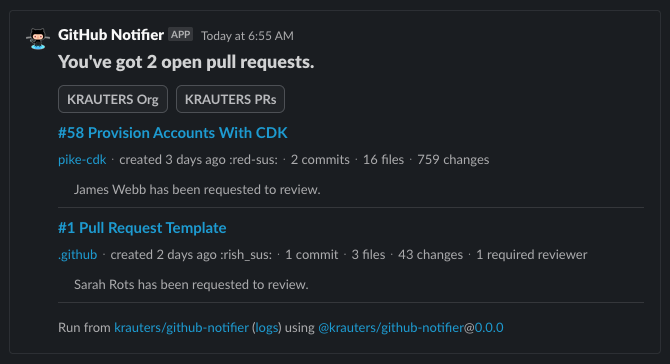
GitHub Notifier is a TypeScript GitHub Action that posts open pull requests to Slack channels based on scheduled jobs. It queries GitHub orgs for repositories, checks for open PRs, matches GitHub users to Slack users, and builds Slack messages to remind teams about pending code reviews.
Key Features
- Posts open PR notifications to Slack with user matching and mentions
- Configurable scheduling via GitHub Actions workflow automation
- Scans repositories across multiple GitHub organizations
- Available as both a GitHub Action and an NPM package
Write It Down
Engineers solve problems. There can't be anything more important than a clearly defined problem, otherwise known as a requirement.
User stories are a fantastic formula for writing one down because they carry the bare minimum context: this user is facing this need, and solving it will provide this value. That formula works for features, and it works for bugs too.
Writing things down, especially as requirements, empowers teams to collaborate well, stay on the same page, and criticize the actual report instead of each other. Sometimes something is a feature, not a bug. Sometimes somebody has a real need, but only because they don't know how the system works, or that a feature already exists that could serve them. With clear problems, engineers can plan and implement effectively, a team can communicate well, and a business can move forward aware of its own history. This is how you avoid repeating mistakes.
I took much of this from my time at Amazon, where the writing is second to none. Teams write business value documents, requirements documents, high and low level design documents, one pagers, and that is just the tip of the iceberg. The culture there says every meeting must have a collaborative document where folks can easily leave comments and questions. Just about every meeting starts with fifteen minutes of silence while everyone reads the document and leaves comments. Then a brief touch base: any high level thoughts before we dive into the comments? The meeting leader walks through every comment and leaves updates right in the document. There is a paper trail, everybody has been heard, and every topic gets addressed.
Laws I Keep in Mind
Named laws and razors I keep coming back to. Old ideas that still explain a lot of what goes sideways on a project, and how to keep it from happening twice. Each one links out if you want the full story.
- Parkinson's Law
Work expands to fill the time you give it. Tight deadlines force real decisions.
- Hofstadter's Law
It always takes longer than you expect, even after you account for this law.
- Hanlon's Razor
Don't assume malice when a plain mistake or a bad day explains it just as well.
- The Pareto Principle80/20
Most of the value comes from a small slice of the work. Find that slice first.
- The Peter Principle
People get promoted until they land in a job they're not good at, and then they stay.
- Hick's Law
More choices means slower decisions. Cut the options and people move faster.
- Goodhart's Law
Once a number becomes the target, people game it and it stops meaning anything.
- The Dunning-Kruger Effect
The less you know about something, the more sure of yourself you tend to be.
- Occam's Razor
When two explanations both fit, the one with fewer moving parts is usually right.
- Chesterton's Fence
Don't tear down a fence until you understand why someone put it up.
- Brooks's Law
Adding people to a late project makes it later. New hands need ramp-up first.